House of Bishops issues report of meeting and a statement on IICSA report
The Church of England’s House of Bishops has issued this statement:
Meeting of the House of Bishops
The House of Bishops met at Bishopthorpe Palace from 15th to 17th May 2019.
Brexit was on the agenda as the bishops discussed recent political developments and prayed for the nation.
The bishops discussed mission and ministry in covenant with the Methodist Church, financial priorities in Church funding over the next three years, and the ministry of confession. The bishops also spent time reviewing progress that has been made by the Living in Love and Faith working group.
The Independent Inquiry into Child Sexual Abuse’s (IICSA) recently published report into the Church of England also received attention from the bishops who have additionally made a statement. [see below]
Elsewhere on the agenda the bishops gave time to the subject of women and men in ministry in the Church of England and mutual flourishing. They discussed the process for discerning how people are called to the ordained ministry.
The House of Bishops also took note of the recent meeting of the Anglican Consultative Council meeting in Hong Kong and anticipated the Lambeth 2020 meeting in Canterbury next summer.
The additional statement referred to above is as follows:
4 CommentsStatement on IICSA report from members of House of Bishops
A statement from members of the House of Bishops in response to The Anglican Church Case Studies IICSA report:
“We write on behalf of the whole House following the publication last week of the IICSA report into the Peter Ball and Chichester Diocese case studies. We recognise that the publication of this report causes most hurt and concern to survivors themselves. It reopens wounds.
“At this week’s meeting of the House of Bishops, Archbishop Justin asked every one of us to read and study the full report in detail and we are absolutely committed to this. The Church has failed survivors and the report is very clear that the Church should have been a place which protected all children and supported victims and survivors. We are ashamed of our past failures, have been working for change but recognise the deep cultural change needed takes longer than we would like to achieve.
“We welcome the recommendations.
“The report will now go to the National Safeguarding Steering Group next month so the Church can formulate a detailed response to the findings and recommendations as we approach IICSA’s wider Church hearing in July. The lead bishop for safeguarding has been asked to report back to the House and to General Synod.
“It is absolutely right that the Church at all levels should learn lessons from the issues raised in this report and act upon them”
Bishop Paul Butler
Bishop Christine Hardman
Bishop Peter Hancock
Bishop Sarah Mullally
Bishop of Lincoln suspended from office for alleged safeguarding failure
Updated again Friday evening
The Archbishop of Canterbury has issued the following statement:
Archbishop of Canterbury statement on Bishop of Lincoln
“Following information provided by the police, I have suspended the Bishop of Lincoln Christopher Lowson from office, having obtained the consent of the Bishops of Birmingham and Worcester (the two longest serving bishops in the Province of Canterbury). If these matters are found to be proven I consider that the bishop would present a significant risk of harm by not adequately safeguarding children and vulnerable people. I would like to make it absolutely clear that there has been no allegation that Bishop Christopher has committed abuse of a child or vulnerable adult. The Bishop of Grimsby, David Court, will take on episcopal leadership of the diocese. It should be noted that suspension is a neutral act and nothing further can be said at this stage while matters are investigated. I ask for prayers for all affected by this matter.”
Commenting today the Bishop of Lincoln said: “I am bewildered by the suspension and will fully cooperate in this matter. For the sake of the diocese and the wider Church I would like this to be investigated as quickly as possible to bring the matter to a swift conclusion.”
The Lincolnshire Police have issued this statement, as reported in local newspapers:
A Lincolnshire Police spokesman said: “We are aware of the decision today of the Archbishop of Canterbury to suspend the Bishop of Lincoln from office and it would not be appropriate for us to comment on that decision.
“The first phase of the Lincolnshire Police Operation Redstone investigation into historic sex abuse cases involving contact resulted in three men being convicted.
“Phase 2 of the investigation is continuing into wider safeguarding issues and management decisions within the diocese. Because it is a live investigation and we do not want to jeopardise the outcome, we do not intend to make any further comment.
“We are committed to ensuring the safeguarding of victims and continue to work with the full co-operation of the Lincoln Diocese.
“There is an absolute multi-agency commitment to a transparent, survivor-focused and diligent investigation of every matter raised with the team. Anyone wanting to make contact in complete confidence can do so to the Diocese Safeguarding Adviser, Debbie Johnson who can be contacted on 01522 504081.”
The Diocese of Lincoln has published the text of an Ad Clerum about this. I recommend reading this in full.
Media coverage:
BBC Bishop of Lincoln Christopher Lowson suspended from office
Church Times Bishop of Lincoln ‘bewildered’ by his safeguarding suspension
The Lincolnite Bishop of Lincoln suspended
Lincolnshire Live Bishop of Lincoln suspended by Archbishop of Canterbury
Guardian Bishop of Lincoln suspended over safeguarding issues
Times (£) Bishop suspended in abuse ‘cover-up’
UPDATE
The Lincolnite reports that an additional fourth person is implicated in the cathedral matter: The four senior figures embroiled in the safeguarding scandal at Lincoln Cathedral
Anglican Communion News Service has a full report: Bishop of Lincoln suspended after information received by the Archbishop of Canterbury.
69 CommentsGeorge Bell Group issues new statement
The George Bell Group has issued this: Statement May 2019.
25 CommentsSince October 2015 when the Archbishops’ Council announced that they had paid compensation to the woman given the pseudonym ‘Carol’, who alleged that she had been abused by Bishop George Bell, his defenders have criticised the Church authorities for never once affording the Bishop the presumption of innocence. Now, after the inquiries of Lord Carlile and Timothy Briden, it can be seen that the allegations against Bishop Bell were unfounded in fact.
THE CARLILE REVIEW
The Carlile report, whose conclusions (save as to publicity) the Church accepted, criticised the investigation of Carol’s allegations as a rush to judgment predicated on Bell’s guilt. It concluded that the decision to settle with Carol was indefensibly wrong and that the process completely ignored the Bishop’s reputation and the interests of his surviving family, including his very elderly niece.
The original statement by the Archbishops’ Council in October 2015 claimed that none of the expert independent reports had found reason to doubt Carol’s veracity. But Lord Carlile discovered that the only expert consulted by the Church thought it very likely that Carol’s experience of abuse in her first marriage had affected her recall, and that the possibility of false memories was a real one.
Regrettably Archbishop Welby added his authority to the destruction of Bell’s reputation: on Good Friday 2016, before the Carlile report was completed, he told BBC Radio that the investigation of Carol’s claim had been ‘very thorough’ and the finding of abuse correct on the balance of probabilities. We now know how far from the truth that was.
The Archbishop told Lord Carlile during his inquiry that if there had not been a proper investigation of Carol’s story, the Church would have to apologise. But sadly, when the Carlile report was published in December 2017, he chose not to do so. To the disappointment of Bell’s defenders, he appeared to reject the presumption of innocence; instead he commented that there was still ‘a significant cloud’ left over Bishop Bell’s name without giving any explanation of why he continued to hold that view in the face of Lord Carlile’s conclusions.
THE ‘FRESH INFORMATION’ AND THE BRIDEN PROCESS
The publicity given to the Carlile report appears to have triggered a copy-cat claim by the woman given the name Alison. The Core Safeguarding Group which had been responsible for the shambolic investigation of Carol’s claim now set about trying to substantiate that by Alison. They may well have hoped that the similar facts alleged by Alison would corroborate the discredited Carol. But within weeks the police, to whom the Core Group had reported the matter, closed their enquiries. Next an investigation by a senior retired police officer commissioned by the Church quickly showed that Alison’s evidence was unreliable and incapable of supporting any adverse finding against the Bishop.Mr Briden reported that her account not only had internal inconsistencies but was also contaminated by her having read Carol’s story, a contamination revealed by her repeating verbatim some of Carol’s words which had been reported in the press. He ended his report by saying that all the allegations against George Bell remitted to him were unfounded.
Many will have hoped that on reading Mr Briden’s report Archbishop Welby would have publicly acknowledged that the cloud of which he had previously spoken had been dissipated. He did not do so.
THE DUTY OF THE CHURCH NOW
The history of the treatment by the Church of England of the reputation of George Bell has become a scandal. It is now the plain duty of the Church of England, nationally and in the Diocese of Chichester, to make amends by working to restore Bishop Bell’s reputation, not least in institutions which were once proud to adopt his name.
We welcome the decision of Canterbury Cathedral to revive a commission to create a statue of Bell and note the expression of ‘delight’ with which the Archbishop of Canterbury has responded. We acknowledge with gratitude the firmness with which the Dean and Chapter of Christ Church, Oxford have maintained and cherished the chapel there dedicated to Bell’s memory throughout the controversy. We note that the meeting room dedicated to Bishop Bell remains, as before, at the World Council of Churches in Geneva.
It is only in Chichester itself, the place in which Bishop Bell lived and worked for almost thirty years and where his ashes are interred in the cathedral, that any public adoption of his name is now suppressed.
We find the public stance of the Bishop of Chichester, Dr Martin Warner, incomprehensible and indefensible. The Bishop’s ‘Response’ to the Briden Report, published on 24 January 2019 and now promoted on the websites of the diocese and cathedral, only went as far as to acknowledge that ‘Bishop Bell cannot be proven guilty’. He added that it could not be ‘safely claimed that the original complainant [i.e. Carol] had been discredited’. This is a most regrettable insinuation that there was, or likely was, substance to Carol’s allegation and hence that Bell was to be suspected of abuse.
The Bishop emphasised the defamatory innuendo by asking ‘those who hold opposing views on this matter to recognise the strength of each other’s commitment to justice and compassion.’ There is, regrettably, no evidence in this response of the Bishop’s commitment to justice or of any compassion towards those who are wrongly accused. His words have been repeated verbatim by the Bishop at Lambeth in response to a Question at the recent session of the General Synod of the church. Indeed, the Bishop even invoked the authority of the House of Bishops in support of this view. So far as we are aware the House has never even discussed the matter.
Such words simply preserve the impression that there was, and remains, a case against Bell. A not dissimilar state of mind was revealed by the Chichester Diocesan Safeguarding Officer when he told the Child Abuse Inquiry in March 2018 that ‘all the indications we have would suggest that the simplest explanation for why someone comes forward to report abuse – because they were abused – is likely to be the correct one’.
As the High Court Judge Sir Richard Henriques has pointed out in his report to the Metropolitan Police on allegations against prominent individuals, such an assumption results in an investigation which does not challenge the complainant, tends to disbelieve the suspect and shifts onto the suspect the burden of proof, ignoring any presumption of innocence. It becomes a premise for a miscarriage of justice such as can now be seen to have been inflicted on the reputation of George Bell.
It should be sufficient to observe that like Professor Anthony Maden, Lord Carlile did interview this first complainant. We note Lord Carlile’s statement of 1 February 2019, made to the local campaigner Mr Richard Symonds: ‘The Church should now accept that my recommendations should be accepted in full, and that after due process, however delayed, George Bell should be declared by the Church to be innocent of the allegations made against him.’
We are more than conscious that this saga represents a wider pattern in the Church and across society where many other such miscarriages of justice have become notorious. Now it is surely essential that if all the many safeguarding bodies, national and diocesan, are to be retained by the Church of England their work must be placed under real legal discipline and in the hands of officers who observe fully the expectations and rule of law and act without fear or prejudice.
There must never again be any repetition of such a discreditable, indeed disgraceful, performance.
Andrew Chandler, Convenor of George Bell Group, 9 May 2019
IICSA publishes report on Chichester and Peter Ball
IICSA has published its report on the Chichester diocese and Peter Ball investigations.
Full Text of Report: Anglican Church Case Studies: Chichester/Peter Ball Investigation Report
Executive Summary, Conclusions and Recommendations
Press release: Inquiry publishes report into the Diocese of Chichester and Peter Ball
The Church of England has published this: Publication of IICSA report into Anglican Church
33 CommentsThe Independent Inquiry into Child Sexual Abuse, IICSA, has today published its report into the Anglican Church based on its case studies last year of the Diocese of Chichester and the response to allegations against the former Bishop of Gloucester, Peter Ball.
The 252-page report makes 5 recommendations about a range of issues. These will now be studied in detail and a full response released at a later date. The Inquiry’s third and final hearing in the Anglican church case study will start on Monday 1 July 2019 and run for two weeks. This will focus on both the Church of England and the Church in Wales in the context of their responses to allegations of child sexual abuse. The Inquiry notes that further recommendations directly relating to the findings in this report will be made following the hearing in July.
The Bishop of Bath and Wells, Peter Hancock, the Church’s lead bishop for safeguarding, said:
“We thank the Inquiry for the report and note the findings and recommendations which we will now study in full. The report states that the Church of England should have been a place which protected all children and supported victims and survivors and the Inquiry’s summary recognises that it failed to do this. It is absolutely right that the Church at all levels should learn lessons from the issues raised in this report.
“Whilst the report acknowledges the progress the Church has made in safeguarding, we recognise that our work must continue at pace in order that we can ensure that the Church is as safe as possible for all. We are committed to working to bring in specific changes that will help us better protect children and vulnerable adults from sexual and all other forms of abuse. If anyone is affected by today’s report I would urge them to come forward. Details of how to do this can be found on the Church of England website.
“We are immensely grateful to survivors for their courage in coming forward to IICSA to share their experiences of how they were treated by the Church, knowing how difficult this would have been; their testimonies have made shocking and uncomfortable listening. Since the Archbishop of Canterbury asked for the Church of England to be investigated by IICSA as a matter of priority, we have sought to help the Inquiry in every way that we can and we will now fully consider the report.”
Church of England report on The Seal of the Confessional
The Church of England has today published two items:
Report of the Seal of the Confessional Working Party
Interim Statement on The Seal of the Confessional
The former is an 84 page report.The working party membership was:
- Rt Revd Paul Butler, Bishop of Durham (Chair)
- Rt Revd Mark Sowerby, Bishop of Horsham (Vice-Chair)
- Fr Andrew Cole Ecumenical (Roman Catholic) representative, Private Secretary to the Bishop of Nottingham and Parish Priest of Grimsby, Cleethorpes and Immingham
- Revd Dr Michael Lloyd, Principal, Wycliffe Hall, Oxford [June 2015 to November 2015]
- Professor David McClean CBE QC Emeritus Professor, School of Law, University of Sheffield
- Very Revd Andrew Nunn, Dean of Southwark (& member of General Synod)
- Fr Thomas Seville CR, Community of the Resurrection, Mirfield (a member of Faith and Order Commission and the General Synod)
- Ven Cherry Vann, Archdeacon of Rochdale (Prolocutor of the Northern Convocation & General Synod member)
- Dr Jane Williams, Assistant Dean & Lecture in Systematic Theology, St Mellitus College [February 2016 to January 2017]
- Graham Wilmer MBE Founder, Lantern Project and member of the National Safeguarding Panel
The latter is a 3 page statement signed by William Nye, as Secretary to the House of Bishops. It says, in part:
…In recent decades, churches around the world have begun to face the many ways in which they have failed to keep people safe from abuse and failed to respond well to those who have suffered abuse. Listening to their voices has raised some significant questions about the ‘seal of the confessional’. This became evident, for instance, in the Royal Commission into Institutional Responses to Child Sexual Abuse in Australia, and there has been discussion in the UK context as well.
Two situations in particular have been a focus for attention. The first is where the person confesses to sins that include abuse of a child or vulnerable person. Why should the normal duty on a priest to report such information appropriately not apply? The second is where it is claimed that if the person confessing their sins has referred to abuse committed by them or by someone else, that cannot then be repeated in another context, such as a statement to the police. This is simply wrong:the ‘seal of the confessional’ applies to the priest who hears the confession, not tothe person who makes it.
In response to these concerns, the Archbishops’ Council and the House of Bishops of the Church of England commissioned a Working Party on the Seal of the Confessional. It first met in 2015 and completed its report in 2017. As well as examining legal, historical and theological perspectives, it received evidence from survivors of abuse and from clergy who have extensive experience of the ministry of confession.
At present, the ‘seal of the confessional’ is upheld in the Church of England’secclesiastical law. The Working Party did not reach a consensus as to whether this should change. The diversity of view within the Working Party would be reflected more widely in the Church of England. Some Anglicans feel very strongly that the ministry of confession is an integral part of the church’s life of the church, and that its proper practice is inseparable from the unqualified observance of the seal. Some observe from their experiences that the Seal of the Confessional can offer comfort to survivors of abuse who, trusting in the absolute discretion it promises, may confide in a priest for the first time and by so doing find that they are able to unburden themselves and begin the process of healing. Others feel very strongly that the church cannot continue with any aspect of its practice that stops information being passed on which could prevent future abuse or enable past abusers to be brought to justice. The House of Bishops has been giving these issues very careful consideration
The Working Party was, however, unanimous in its recommendations in a number of key areas. One was for improvements to training on the ministry of confession in relation to safeguarding issues, with training itself becoming obligatory for all those ordained as priests, since any priest might be asked to do this. Another was for the appointment of an adviser on the ministry of reconciliation in each diocese who can be a point of reference for training, supervision and advice.
The House of Bishops is fully supportive of these recommendations. Addressing them has required consultation with a number of different groups and individuals. Further information will be given in due course about how the agreedrecommendations of the Working Party’s report will be taken forward.
Sarah Bullock to be next Bishop of Shrewsbury
10 Downing Street has announced that Sarah Bullock, Archdeacon of York in the Diocese of York, is to be the next Bishop of Shrewsbury in the diocese of Lichfield.
The Queen has approved the nomination of The Venerable Sarah Ruth Bullock, BA, Archdeacon of York in the Diocese of York, to the Suffragan See of Shrewsbury, in the Diocese of Lichfield, in succession to the Right Reverend Mark Rylands, MA who resigned on 31st July 2018.
Background
Sarah was educated at Surrey University and she trained for ministry at Cranmer Hall, Durham. She served her title at St Paul, Kersal Moor in the Diocese of Manchester and was ordained Priest in 1994.
Sarah was appointed Priest-in-Charge of St Edmund, Whalley Range in 1998 and later additionally became Priest-in-Charge of St James with St Clement, Moss Side in 1999, before becoming Rector of the joint benefice in 2004. She also held the role of Diocesan Vocations Adviser from 1998 until 2005. Sarah was made an Honorary Canon of Manchester Cathedral in 2007, and took on the additional roles of Bishop’s Adviser for Women’s Ministry in 2009, Borough Dean for the City and Borough of Manchester in 2010 and Area Dean of Hulme in 2012. In 2013, Sarah was appointed Archdeacon of York.
The diocese of Lichfield website carries this story here.
8 CommentsJoanne Grenfell to be next Bishop of Stepney
10 Downing Street has announced that Joanne Grenfell, Archdeacon of Portsdown in the Diocese of Portsmouth, is to be the next Bishop of Stepney in the diocese of London
The Queen has approved the nomination of the Venerable Dr Joanne Woolway Grenfell, Archdeacon of Portsdown, in the Diocese of Portsmouth to the Suffragan See of Stepney, in the Diocese of London in succession to the Right Reverend Adrian Newman, BSc, MPhil who resigned on 31st December 2018.
Background
The Venerable Dr Joanne Woolway Grenfell was educated at Oriel College, Oxford, where she was also Lecturer in English. She trained for ministry at Westcott House, Cambridge. She served her title at Kirkby Team Ministry in the diocese of Liverpool, and was ordained Priest in 2001. In 2003, Joanne was appointed Priest-in-Charge of Manor Parish in the diocese of Sheffield with responsibility for Ripon College Cuddesdon’s urban theology placement programme. In 2006, Joanne became Diocesan Director of Ordinands and Residentiary Canon, and in 2008 she took on the additional role of Dean of Women’s Ministry. Joanne became Archdeacon of Portsdown in 2013.
The diocese of London website carries this story here.
Dagmar Winter to be next Bishop of Huntingdon
10 Downing Street has announced that Canon Dagmar Winter is to be the next Bishop of Huntingdon in the diocese of Ely.
The Queen has approved the nomination of the Reverend Canon Dagmar Winter, DrTheol, Rector and Lecturer of St Andrew, Hexham, in the Diocese of Newcastle to the Suffragan See of Huntingdon, in the Diocese of Ely, in succession to the Right Reverend David Thomson who resigned on 31st October 2018.
Background
Dagmar was educated at the universities of Aberdeen and Heidelberg and she trained for ministry at Herborn Theological Seminary. She served her title at St Mark, Bromley in the Diocese of Rochester and was ordained Priest in 1997. In 1999, Dagmar was appointed Associate Vicar of St Andrew, Hexham, and Deanery Training Officer, and in 2006 she became Priest-in-Charge of St Bartholomew, Kirkwhelpington with Kirkharle, Kirkheaton, and Cambo, and also held the role of Diocesan Officer for Rural Affairs during this time. She was made an Honorary Canon of Newcastle Cathedral in 2011. Additionally, she has been a member of General Synod since 2005, served as Area Dean of Morpeth between 2011-2013, and has been the Bishop’s Advisor for Women in Ministry since 2012. In 2015, Dagmar took up her current post of Rector and Lecturer of St Andrew, Hexham (Hexham Abbey).
The diocese of Ely website carries this story here.
Opinion – 4 May 2019
Women and the Church Twenty-five years on; reflections on ministry
“Did I have a cure of souls?” — memories of one of the woman who were ordained in the diocese of Winchester on 24 April 1994
Andrew Foreshew-Cain ViaMedia.News Integrity, Compromise & the Church of England
Catherine Haydon A Blaze of Light Always Lent, Never Easter
Damon Rose BBC Stop trying to ‘heal’ me
Ines Hands Church Times Liturgy is an anchor — don’t brush it aside
“Parishes that have dispensed with centuries of tradition need to consider what is being lost”
Church Times ‘Sex is irrelevant to this office’
Fifty years ago this month, it became possible for women to be Readers. Some describe the journey
Graham Usher to be next Bishop of Norwich
10 Downing Street announces:
Bishop of Norwich: 3 May 2019
The Queen has approved the nomination of The Right Reverend Graham Barham Usher for election as Bishop of Norwich.
The Queen has approved the nomination of The Right Reverend Graham Barham Usher, BSc, MA, Suffragan Bishop of Dudley, for election as Bishop of Norwich in succession to The Right Reverend Graham Richard James, BA, following his resignation on 28th February 2019.
Background
The Right Reverend Graham Barham Usher, studied ecological science at the University of Edinburgh and theology at Corpus Christi College, Cambridge. He trained for ministry at Westcott House, Cambridge. He served his title at St Mary the Virgin, Nunthorpe, in the Diocese of York and was ordained priest in 1997. Following the completion of his curacy in 1999, Graham was appointed Vicar of Holy Trinity, North Ormesby. In 2004 he became Rector of Hexham in the Diocese of Newcastle and had the additional responsibility of Area Dean of Hexham between 2006 and 2011. In 2007 he was also appointed Honorary Canon of St Cyprian’s Cathedral in Kumasi, Ghana.
Graham took up his current appointment as Bishop of Dudley in 2014. Graham maintains an interest in ecology as one of the Church of England’s environmental bishops and in medical ethics as a board member of the Human Tissue Authority.
The Diocese of Norwich has more:
Next Bishop of Norwich announced
Downing Street has today announced that the Rt Revd Graham Usher will become the 72nd Bishop of Norwich.Bishop Graham, 48, is currently the Bishop of Dudley. Prior to this he was Rector of Hexham in Northumberland, following his time working in Middlesbrough. He has also spent time living and working in Ghana, Africa.
Following the announcement, Bishop Graham will tour the Diocese this afternoon, including visits to a local housing trust, a primary school garden and outdoor reflective space, a church after-school club run by volunteers, and culminating in a special Evensong at Norwich Cathedral to which everyone is invited…
Later in the same press release, it says:
…As Bishop of Dudley since 2014, Bishop Graham has served the people of the Diocese of Worcester, working particularly in the areas of clergy wellbeing and vocation, parish mission weekends and pilgrimage walks, leading on safeguarding, establishing two resourcing churches, and supporting ministry in schools. He has chaired the Churches’ Housing Association of Dudley and District which provides the women’s refuge, housing for homeless teenagers, and residential support for elderly people who live with long-term mental ill health. Within the civic life of Dudley he has served as Dudley Council’s Independent Person for standards and led the community strand of the ‘Forging Ahead’ vision for Dudley.
Bishop Graham maintains an interest in ecology as a member of the Church of England’s Environmental Working Group and in medical ethics as a board member of the Human Tissue Authority. He is a member of the International Commission for Anglican Orthodox Theological Dialogue. He is a keen beekeeper and regularly tweets @bishopdudley. He has written about spirituality and landscape: Places of Enchantment, Meeting God in Landscapes.
You can watch his initial remarks following the announcement on YouTube at https://youtu.be/tycJgGJAqhs, where he talks about the awe-inspiring Christian faith, the Christ-like humility we seek as Christians, and the calling of the Church to offer all that it can in love. “I’m looking forward to leading a diocese that seeks, by the power of the Holy Spirit, to inspire the imagination of more people, especially the young, about the Christian faith.”
Bishop Graham is married to Rachel, a GP, and they have two teenage children. He studied ecological science at the University of Edinburgh and theology at Corpus Christi College, Cambridge, before training for ministry at Westcott House, Cambridge. Following his ordination as a deacon in 1996, he began his ministry in Middlesbrough in the Diocese of York, first as curate at St Mary the Virgin, Nunthorpe, and then as Vicar of Holy Trinity, North Ormesby, a parish with severe levels of social need and child poverty. In 2004 he became Rector of Hexham in the Diocese of Newcastle and had the additional responsibility of being Area Dean of Hexham between 2006 and 2011. In 2007 he was also appointed Honorary Canon of St Cyprian’s Cathedral in Kumasi, Ghana, the place of his early childhood.
More fallout from the Panorama programme
An open letter has been published by Justin Humphreys, chief executive of the charity now known as thirtyone:eight (formerly Churches Child Protection Advisory Service):
An open letter to the leadership of the Church of England following BBC’s Panorama.
…It has been clear for some time that the past cases review conducted between 2007 and 2010 was flawed in a number of respects. For there to be any confusion or uncertainty about what happened to those cases that were identified, often referred to as the ‘Known Cases Lists’ is also inexcusable. The Panorama program did well to uncover what were clearly points of discomfort for the church hierarchy. For key representatives of the Church to either not be able to respond clearly to questions about the number of cases or be unprepared to do so, calls the management of these cases into serious question and makes one wonder who exactly is in control? The need for transparency and true accountability has never been as needed as it is today.
What is needed within the Church of England (and frankly elsewhere across the wider Church and beyond) is authentic leadership. Leadership that is prepared to lead by example in a proactive exercise of self-reflection that leads to open and honest dialogue (particularly with survivors). Leadership that is not governed, coerced or muzzled by either insurers, lawyers or any other stakeholder that may stand to lose from just exposure and open remorse and repentance. This would be the right thing to do!
We may ask, what (or who) is being served by this ongoing catalogue of failures, missed opportunities and resistance to effective change concerning past, present and future safeguarding matters? It certainly cannot be said that survivors are being well-served. It is also of great concern that the Church itself is being further damaged by a continual denial of the truth and avoidance of any tangible reparation.
If the public at large is ever again to say of the Church that it is a safe place, a haven or even a sanctuary for those who are suffering, the Church must be prepared to be laid bare and be held accountable for those things it has failed to do well. This humility would be the greatest strength of the Church in seeking to deal with this sad catalogue of shame. The time has come for those that stand in the way of what Jesus would so clearly have done to be challenged, held accountable and where needed placed elsewhere – where they have less opportunity to exert their negative influence and to stand in the way of the restoration that is desperately needed…
Do read the whole letter.
Stephen Parsons at Surviving Church has written a second blog, this one is titled: Panorama on C/E. Further reflections. Again it’s worth reading in full, but the concluding paragraph says:
…Panorama indicated to us that control of information is a tactic of power still actively employed by the central Church authorities. The originators of this tactic do not appear to be the bishops themselves but the highly paid Church House officials at the centre of things. Unfortunately for them, their control of the levers of power was all too easy to spot in both the recent television interviews. The interview of Archbishop Welby on Channel 4 was, like that of Bishop Hancock, unconvincing and somewhat contrived. The bishops themselves both had personal integrity and human warmth but nothing could not disguise the fact that they were speaking for someone other than themselves. The Church cannot continue to go down a path of fielding individuals to act as spokesmen for the institution. The public want, as far as possible, to encounter real human beings who can speak for the church. The people of England relate to real people, people who, like them, are living lives of joy mixed with pain. They will never want to identify with a group when they suspect that the information put out is being manipulated and managed before it is shared with them. In short, let bishops be bishops, shepherds of the flock, not puppets being controlled by forces that are invisible and are not necessarily working for the good of all.
The Church Times has published a letter from Andrew Graystone which can be found here (scroll down)
23 CommentsPanorama programme won’t be the last scandal
Sir, — Church leaders, from the Archbishops up, acknowledge that the Church is failing in its care of victims of clergy abuse. But ask them who is responsible for sorting out the mess, and nobody knows. Is it the job of the Archbishops’ Council? or the General Synod? or the National Safeguarding Steering Group? or Lambeth Palace? or the House of Bishops? Or is it, perhaps, a matter for each individual diocese?
Everybody points to someone else. Nobody steps forward. After a decade or more of crisis, which continues to eat away at the Church’s standing in society, there has been a complete failure from those in authority to grasp the issue. One reason that some survivors of church abuse are so painfully vocal is that they are filling a vacuum of leadership on this most crucial of issues for the Church.
Monday’s Panorama, with its focus on the shameful mismanagement of abuse in Lincoln diocese, was entitled Scandal in the Church of England. It could have been made at any point in the past decade, and it could have focused on almost any diocese. Stories will continue to emerge, and the scandal of abuse past and present will continue to undermine the Church’s wider mission, until some individual or body takes responsibility and institutes decisive action.
In the mean time, it is victims of abuse, past and present, who bear the cruelty and pain of the Church’s failure.
Bishop of Horsham to become Principal of the College of the Resurrection
News from the Diocese of Chichester
Bishop of Horsham to be Principal of the College of the Resurrection
The Bishop of Horsham, The Right Reverend Mark Sowerby, has been appointed as the new Principal of the College of the Resurrection, Mirfield.
Bishop Sowerby, who has been a suffragan bishop in the Diocese of Chichester since 2009, will be returning as Principal to the College where he was a student…
Former Student Returns as Principal
Bishop Mark Sowerby is to be the next Principal of the College of the Resurrection in succession to Fr Peter Allan CR, who will retire at the end of the academic year. With his wife, Ruth, he will move to Mirfield from the Diocese of Chichester, where he has been Bishop of Horsham since 2009.
Bishop Mark, who has three adult daughters, is no stranger to the north nor, indeed, to Mirfield. Born in Ripon, he trained for ordination at the College of the Resurrection, served his first curacy in Knaresborough, and after several years in the Blackburn Diocese, spent eight years at St Wilfrid’s, Harrogate. From 1997-2001, Bishop Mark served as the Church of England’s Vocations Officer and as a Selection Secretary for the Ministry Division. More recently he has chaired the national Safeguarding Training Working Group…
Christian Today reports the news: Mark Sowerby to become principal of the College of the Resurrection after 10 years as Bishop of Horsham.
3 CommentsBBC Panorama documentary about Safeguarding in the CofE
Updated again Tuesday afternoon
The BBC is due to broadcast a documentary this evening, titled Scandal in the Church of England.
The 30 minute programme is now available to view at the above link.
Somewhat unusually, the Church of England issued a statement about this programme last Friday:
BBC Panorama this Monday (April 29) will feature interviews with survivors of church-related abuse in a programme entitled ‘Scandal in the Church of England’. We have worked with the producers to provide information and a response to the range of issues raised, particularly around the Past Cases Review. There will be a personal response from Bishop Peter Hancock, the Church’s lead safeguarding bishop, once the programme has been aired. Bishop Peter has also been interviewed for the programme.
There have been several media reports ahead of broadcast:
BBC Jane Corbin Two former Bishops of Lincoln failed to act on abuse allegations
Rutland and Stamford Mercury Bishop of Grantham ‘very sorry’ over reports Diocese of Lincoln failed to properly handle historic abuse allegations and Prepare for “difficult and shocking things” warns Bishop of Grantham over Panorama historic abuse programme.
The latter helpfully included a link to the lengthy Ad Clerum notice from the Bishop of Grantham issued before the programme was shown, which is also available as a PDF over here. This is quite detailed and worth a careful read.
Following transmission the Church of England has issued this press release:
Bishop Peter Hancock, the Church of England’s lead safeguarding bishop said: “It has been harrowing to hear survivors’ accounts of their abuse – shared on BBC Panorama – and we issue an unreserved apology for how we have failed them. We acknowledge that the Past Cases Review, PCR, from 2008-10, however well-intentioned was in hindsight clearly flawed, as shown in the independent scrutiny report by Sir Roger Singleton published last summer. The ‘stringent criticisms’ of the PCR, shared with IICSA, are being acted upon and all dioceses are now carrying out a second past cases review, PCR2. We fully acknowledge that it was a serious mistake not to work with and hear from survivors during the original PCR. The new review will ensure survivors voices are heard. We are aware of the courage it takes for survivors to come forward knowing that the effects of their abuse are with them for life.
I would urge anyone affected by the Panorama programme to call the NSPCC helpline number 0808 800 5000.”
Other updates
Stephen Parsons at Surviving Church has this commentary on the programme: Panorama on Scandal in the C/E. Some thoughts. His final conclusions are:
…The programme concluded with a number of story-lines unfinished. There was Matt’s story which still has many unanswered questions to be faced, particularly in respect of his official complaints against named individuals. These remain unresolved. There was also mention of a newly uncovered file in the York diocese mentioning a number of abuse cases that have not been examined. We still were left with the feeling that for whatever reason, the Church remains defensive and highly secretive. Any control of information, which still appears to be happening, is a power tactic. If there is still secrecy and an attempt to bury the past, all such attempts to do this will likely fail. Truth, as I have said before, has a habit of spilling out to the embarrassment of those who want to suppress it. The secrets that are held in order to protect reputations have the capacity to wreak enormous damage on institutions. The Church of England has much to lose if it does not get its house in order over safeguarding.
Christian Today has a detailed report on the programme which usefully includes the text of the media response made by the Bishop of Grantham, The Rt Revd Nicholas Chamberlain:
Whilst some matters remain under investigation it is not possible to comment specifically on the questions that have been posed to the diocese by the BBC.
The Diocese of Lincoln wishes to acknowledge that past matters have not been handled well. The diocese is committed to learn from its mistakes. I am very sorry that it took so long for justice to be served.
The past abuse that our safeguarding team brought to light, through our revisiting and review of past cases, is all the more appalling given what the public deserve and are fully entitled to expect, which is the highest level of conduct from clergy and all those involved in leadership in the church. All people are made in the image of God and abuse of any kind is contrary to that belief.
It is as a result of our commitment to ensuring justice is served, that our safeguarding team have developed an effective partnership with Lincolnshire Police, working together on Operation Redstone. Together they have worked tirelessly to ensure that convictions were secured where possible and where this was not an option, that risk was managed appropriately. Throughout all recent processes our hope is that victims and survivors have felt heard, and been well supported and cared for, although we acknowledge we may not have always got this right.
Every effort is being made to ensure that safeguarding is part of the DNA of the Diocese of Lincoln. There are high levels of confidence in our safeguarding practitioners from Lincolnshire Police and statutory authorities. There is mandatory safeguarding training that is externally audited and independently validated with support from Lincolnshire Safeguarding Children and Adult partnership boards. Our safeguarding team have delivered face to face training to 3296 people in the past five years.
As a diocese we promise to offer support to anyone who contacts us about issues of harm or abuse and are committed to ensure that churches are a safe place for all.
Church Times Hattie Williams Bishop apologises for mistakes after Lincoln abuse featured on Panorama
Press Association via Premier Church of England officials ‘turned blind eye’ to child abuse claims
23 CommentsChair of the York Crown Nominations Commission
Chair of the York Crown Nominations Commission: 25 April 2019
Prime Minister appoints Joëlle Warren, MBE, DL as Chair of the York Crown Nominations Commission.
Published 25 April 2019
From: Prime Minister’s Office, 10 Downing Street and The Rt Hon Theresa May MP
The Prime Minister has appointed Joëlle Warren, MBE, DL as Chair of the York Crown Nominations Commission.
Joëlle Warren serves as Her Majesty’s Vice Lord-Lieutenant for Cheshire, Chair of Cheshire Community Foundation, and served 10 years on the Board of Manchester Metropolitan University, latterly as Vice Chair. She began her business career in banking before founding the executive search firm, Warren Partners, in 1999. She is a Member of the North West Business Leadership Team and the CBI’s Enterprise Forum. Joëlle is actively involved in her local church and in wider work for the Church of England nationally.
Joëlle was appointed MBE in January 2016 for her Services to Business.
The Crown Nominations Commission was established by the Church of England’s General Synod in February 1977. Its function is to nominate new Diocesan Bishops for appointment by The Queen. In the case of appointments to the Archbishoprics of Canterbury and York, the Commission is chaired by an independent person who is a communicant member of the Church of England and not ordained. For the appointment of the Archbishop of York it is a requirement that the Chair should be resident in the Northern Province.
16 CommentsBishop of Chester announces his retirement
The Bishop of Chester, the Rt Revd Dr Peter Forster, has announced that he will be retiring from his role on Monday 30 September 2019, after more than 22 years in the post.
More details are on the diocesan website.
16 CommentsSafeguarding: some further articles
Updated with more articles on Friday
Meg Munn, chair of the Church of England’s National Safeguarding Panel, has written this: QUESTIONING THE TRAINING AND DEVELOPMENT FRAMEWORK. The whole article is worth a read.
On the topic of Victims and Survivors, she wrote this:
The panel was asked to consider a paper on the setting up of an Ombudsman service to adjudicate on the handling of complaints. The view of the panel was that there are currently many concerns among victims and survivors that are not properly handled, that much more needed to be done about the processes at an early stage. I represented this view at the National Safeguarding Steering Group in early April and am pleased that this was understood and consideration to how to proceed is taking place.
The recent report by the Social Care Institute for Excellence which includes a significant section on improving responses provides a lot of important information regarding the experience of a number of survivors of abuse. The findings are detailed and it will take time for the range of issues to be fully considered. What jumps out is the poor ongoing response to survivors. The importance of maintaining contact and keeping survivors up to date with any action is essential.
The recent interview of the Archbishop of Canterbury on Channel 4 news raised concerns about the glacial progress of a review into the activities of John Smyth. While there may be real difficulties in gaining co-operation of the organisation at the centre of this case, the Church must communicate more regularly and clearly about their actions otherwise it is not surprising that survivors lose heart. I am urging those concerned to consider how they can proceed as soon as possible.
On the latter point, today’s Church Times has a report by Madeleine Davies headlined Smyth abuse-survivors dispute Welby claim.
SURVIVORS of abuse perpetrated by John Smyth have written to Lambeth Palace to correct the Archbishop of Canterbury’s assertion that Smyth was “not actually an Anglican” — a comment made during an interview on Channel 4 News last week.
In total, the letter lists 14 points of dispute about the Archbishop’s comments.
During the interview on Friday, which explored the Church of England’s response to Smyth’s abuse, Archbishop Welby said that Smyth “was not actually an Anglican. The church he went to in South Africa was not Anglican, and Iwerne was not part of the Church of England.”
Smyth was living in South Africa when a disclosure of abuse was made in Ely diocese in 2013, and died there last year. He was a former chairman of the Iwerne Trust, which ran holiday camps for boys at English public schools, and is now part of the Titus Trust. A six-month Channel 4 News investigation, broadcast two years ago, found that both the Iwerne Trust and Winchester College had learned of allegations of abuse by Mr Smyth in the 1980s, but failed to report them to the police (News, 10 February 2017).
One of the survivors who wrote to Lambeth Palace this week, Graham*, described the claim that Smyth was not an Anglican as “farcical”, given that he worshipped in the C of E.. The letter tells the Archbishop that Smyth had in fact been a licensed Reader in the diocese of Winchester…
Do read the entire article for further details.
Update
Law & Religion UK has published two articles recently discussing Mandatory Reporting. The most recent one is IICSA second seminar on mandatory reporting and the earlier one was IICSA and mandatory reporting of child sexual abuse: update. These contain numerous links to the IICSA materials on this subject, which deserve careful study. L&R UK comments:
25 CommentsAn earlier IICSA seminar on mandatory reporting took place on 27 September 2018 and considered existing obligations to report child sexual abuse in England and Wales, as well as international models of mandatory reporting. A report of that seminar has been published on the website and the 11 presentations are also available to read on the mandatory reporting seminar page.
On 17 April we posted an update on mandatory reporting in which we indicated that Bates Wells Braithwaite had reported that the IICSA was actively considering the question of introducing mandatory reporting of child sexual abuse in England and Wales; the Inquiry has consulted with the Victims and Survivors Forum, a self-nominating group of victims and survivors of child sexual abuse, and has now published a summary of responses: Mandatory reporting of child sexual abuse: A survey of the Victims and Survivors Forum, in which the great majority of respondents from the Forum (88.6%) were in favour of introducing mandatory reporting.
Deborah Sellin to be next Bishop of Southampton
Press release from Number 10
Suffragan Bishop of Southampton: 16 April 2019
Queen approves the nomination of the Reverend Canon Deborah Sellin as Suffragan Bishop of Southampton.
Published 16 April 2019
From: Prime Minister’s Office, 10 Downing Street
The Queen has approved the nomination of the Reverend Canon Deborah Sellin, MA, Vicar of St John the Baptist Wonersh with Blackheath and Area Dean for the Deanery of Cranleigh, in the Diocese of Guildford, to the Suffragan See of Southampton, in the Diocese of Winchester in succession to the Right Reverend Jonathan Hugh Frost, BD, MTh, DUni, MSSTh, FRSA, who resigned on the 13th December 2018.
The Winchester diocesan website has this: A New Bishop for Southampton.
The Guildford diocesan website has this: Wonersh Vicar to be next Bishop of Southampton.
Update on the Lambeth Conference
Updated on 16 April
Two letters in The Times yesterday,
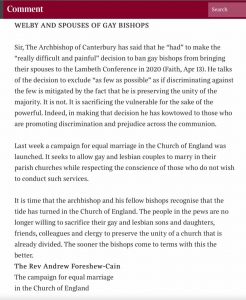 ,
,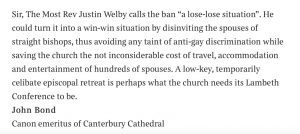
This blog by Marcus Green such a pain includes links to several comments on social media.
Previous report on this topic is here.
Today, Kaya Burgess in The Times (£) reports that Welby says gay bishop spouse ban was ‘painful’ but necessary.
…Speaking on a tour of the diocese of Peterborough, the archbishop said that he had met university bosses to discuss their concerns. He told The Times: “Well over 90 per cent of the Anglican communion are conservative on issues of sexuality. I’ve invited all the bishops, including those in same-sex marriages. And I had to consider . . . getting as many people as possible there and excluding as few as possible. It’s a lose-lose situation.”
He added: “I had to take what is a really difficult and painful decision to say, in order for the conference to be as representative as possible and get all the bishops there and not have the risk of some provinces not coming because they felt I was pushing the envelope too far, that I couldn’t ask all the spouses.”
He described the situation as “just the reality of such a widespread communion . I hope we’ll get to the point where we are able disagree well and that’s while affirming the doctrine of marriage in its traditional Christian form.”
Some earlier reports:
Catherine Pepinster RNS reported on the meeting between the University of Kent and the Conference organisers: Lodging for spouses becomes Anglicans’ latest battleground over LGBT clergy
…Last week the university met with communion officials to raise its “significant ethical concerns” after university Vice Chancellor Karen Cox and council chair David Warren said they had “serious issues,” calling the no-same-sex-spouses policy “contrary to the values” of the university.
Both sides are refusing to divulge what the outcome of the meeting was, but the university has now pledged to make accommodation available to spouses who want to be based in Canterbury with their partners for the duration of the Lambeth Conference — a move that will focus attention even more intensely on the Anglican Communion’s policy of exclusion.
Anglican Communion spokesman Gavin Drake said the Lambeth Conference would go ahead at Kent University in 2020, and he added: “We are not speaking about this issue at all. What Kent does is up to them.”
Mary Frances Schjonberg had a comprehensive catch-up on events up to 2 April: ENS Refusal to invite bishops’ same-sex spouses to Lambeth 2020 draws ire in Britain.
And the latest as of 12 April on registrations from ACNS: Lambeth Conference 2020: Over 500 bishops in 39 Anglican Communion Churches register:
Organisers of next year’s Lambeth Conference of Anglican bishops have announced that 502 bishops and 382 spouses have so far registered for the decennial event, with the numbers rising each day. Registrations to date come from 39 of the Anglican Communion’s 45 member Provinces and Extra Provincial Churches. “In comparison to the 2008 event when registrations had not started at this point, this is a most encouraging position to be in”, Lambeth Conference Chief Executive Phil George said…
And also: The man on a mission to make the Lambeth Conference happen.
29 CommentsCampaign for Equal Marriage in the Church of England is launched
PRESS RELEASE Embargoed until 00.01 Friday 12 April 2019
A new campaign, Equal, the Campaign for Equal Marriage in the Church of England, is being launched to push for change in the official teaching and practice of the Church of England, so as to allow same-gender couples to marry in Church of England churches.
The Campaign has a simple three-point agenda:
- Same-gender couples should be able to be married in Church of England parishes.
- People in such marriages should have the same opportunities for lay and ordained ministry in the Church of England as anyone else.
- The consciences of everyone should be protected – no member of the clergy should be forced to conduct a marriage they disagree with, but also no member of the clergy should be prevented from celebrating a marriage involving a same-gender couple.
We are launching this campaign on Friday 12 April, the fifth anniversary of the marriage of the Revd Jeremy Pemberton to Laurence Cunnington. Jeremy was the first priest of the Church of England to marry a same-gender partner and as a result was denied permission to take up a new post in an NHS Trust.The Church of England officially discriminates against LGBT+ people, in refusing to allow same-gender marriages in its buildings, or by its clergy in any building, and by excluding from its ministry both lay and ordained people who have so married. The Campaign believes that it is time for this to change. The Church of England should end this injustice and respect the consciences of the increasing majority of its members, who are supportive of gay and lesbian relationships (http://www.brin.ac.uk/figures/attitudes-towards-gay-rights/).
The Revd Andrew Foreshew-Cain, who is one of the team leading the new Campaign, said ‘We congratulate Jeremy and Laurence on their wedding anniversary, and rejoice with the many same- gender couples who have made lifelong, faithful commitments to each other in marriage in recent years.
‘The Church of England has spent too many years saying that it is sorry for the way that it treats LGBT+ people and condemning discrimination and prejudice, whilst at the same time continuing its own injustice towards us in marriage and ministry. It is time for what is done to match what is said, and for the Church of England to respect the conscience of the majority who are warmly supportive of same-gender relationships.
‘The Campaign is formed of faithful Anglicans who want to see change, and we will continue to work and pray for the day when any couple, gay or straight, can walk down the aisle of their local church to make their vows.’
Press enquiries to: info@cofe-equal-marriage.org.uk or Fr Andrew Foreshew-Cain on 07812 453230
Website: https://www.cofe-equal-marriage.org.uk/
23 CommentsThe CofE appoints its first permanent national Director of Safeguarding
The Church of England announced today that Melissa Caslake, Executive Director of Children’s Services for the Royal Borough of Kensington and Chelsea and City of Westminster, has been appointed as its first permanent Director of Safeguarding.
First national Director of Safeguarding appointed
10/04/2019
Melissa Caslake, Executive Director of Children’s Services for the Royal Borough of Kensington and Chelsea and City of Westminster, has been appointed as the Church of England’s first permanent Director of Safeguarding. She takes over from Sir Roger Singleton who took up an interim role at the beginning of the year.
Melissa has a strong professional background in adult and children’s services over a 20-year career, with particular experience of child protection and safeguarding, and a track record of leading good and outstanding children’s services in local authorities.
As executive director she has overseen the Bi-Borough response to non-current child sexual abuse and been the London lead Director of Children’s Services for unaccompanied asylum-seeking children, working with Government departments to develop a stronger national response. Melissa has overseen the provision of support for children affected by the Grenfell Tower fire, also reporting to the Government’s Taskforce.
Prior to her current role she was Director of Family Services for the City of Westminster where she led the service to an Ofsted ‘outstanding’ rating in 2016. She was formerly a divisional director in the London Borough of Harrow and Director of Children’s Social Care and Youth Inclusion in the London Borough of Merton.
Melissa studied English at Oxford University followed by a Master’s in social work at Exeter University; she also has a range of management and leadership qualifications including from the Warwick University Business School.
Commenting on her appointment Melissa said: “I am proud to be taking on the role of National Director of Safeguarding for the Church of England. My career has been dedicated to safeguarding vulnerable children and adults and helping families in need.
“I am determined to ensure that the Church is a safer place for all, and I look forward to applying my professional experience and expertise to this challenge.”
William Nye, Secretary General to the Archbishops’ Council, said: “I am delighted by the appointment of Melissa Caslake to this role. The Church of England has come a long way in improving its safeguarding of children and vulnerable adults in recent years, particularly since the establishment of the national safeguarding team in 2015. But there is much still to do, and the creation of a director post for safeguarding recognises that.
“We have been fortunate in the last few months to have Sir Roger Singleton filling the post on an interim basis and now to have someone with the experience and seniority of Melissa to fill the post on a permanent basis, and to take the national Church’s safeguarding work to a new level. She will be an excellent addition to the Council’s leadership team, and I am very pleased to welcome her to Church House.”
Bishop Peter Hancock, the Church of England’s lead safeguarding bishop, said: “I welcome the appointment of Melissa as the Church of England’s first Director of Safeguarding. Her strong, professional background and experience will strengthen the National Team as it continues its work at a time of increasing demand. Melissa’s appointment is part of our commitment to ensuring the Church is a safer place for all and she will take on leadership of the team as we approach our main IICSA hearing. I look forward to working with her in my role as lead safeguarding bishop.”
Melissa’s start date will be confirmed in due course.
More information
31 Comments